Vjaġġ tal-Fwieħa Ispirati mill-Kultura Orjentali u mill-Kreattività | ScentSerenade


Żejt Essenzjali tal-Pepermint għall-Ħelsien tal-Uġigħ ta 'ras: The Direct Conclusion
Menta essenzjali oil for headache relief works by targeting the TRPM8 receptor. This is not a placebo. Menthol in the oil activates cold-sensing channels in your skin, which tricks your brain into reducing pain perception. It also increases blood flow to the forehead and relaxes tense neck muscles. Użaha b'mod korrett, and you get relief in 15 minuti. Use it wrong—undiluted, near the eyes—and you get a burning sensation and zero relief. The difference is precision.

1. What Makes Peppermint Oil Different from Ibuprofen?
Ibuprofen blocks COX enzymes systemically. That is a blunt instrument. It works on the whole body, which is why it causes stomach bleeding and kidney stress over time. Menta oil works locally on the trigeminal nerve via menthol. You apply it to the temples, and it changes how that nerve signals pain to the brain. No liver processing. No gut irritation. For tension headaches, this local action is often faster and cleaner than oral drugs.
1.1. The Blood Flow Paradox
Conventional thinking says vasoconstriction (narrowing blood vessels) stops migraines. That is true for some migraine phases. But tension headaches involve muscle tightness that restricts blood flow. Peppermint oil dilates capillaries in the forehead. This flushes out built-up metabolic waste from tense muscles. Ir-riżultat: the muscle relaxes, and the pain stops. This is the opposite of what caffeine does. Know your headache type before choosing.
2. How Does Menthol Trigger Analgesia?
Menthol binds to TRPM8 receptors on sensory neurons. These are the same receptors that respond to cool temperatures. Once activated, the neuron sends a “cool” signal to the brain. But that signal also inhibits the transmission of pain signals from the same area. Dan jissejjaħ counter-irritation. The brain prioritizes the cool sensation over the pain. It is a sensory override, not a chemical block.
3. What Is the Correct Dilution Ratio?
Do not use undiluted peppermint oil on skin. It causes contact dermatitis. For headache relief, uża a 5% dilwizzjoni. Dan ifisser 3 drops of peppermint essential oil per 1 kuċċarina (5 ml) taż-żejt trasportatur. Ġoġoba, coconut frazzjonat, jew żejt tal-lewż ħelu xogħol. Mix them in a small glass bottle. Applika 2 drops of the mixture to each temple, the back of the neck, and the forehead—avoiding the eye orbit by 1 pulzier.
4. Inhalation vs. Topical: Which is Faster?
Inhalation hits the olfactory bulb in 2 biex 3 sekondi. That triggers a reflex rilassament of the diaphragm and neck muscles. It is excellent for nausea accompanying a headache. But the analgesic effect on forehead blood vessels is minimal. Topical application on the temples and neck is faster for localized pain relief. For maximum speed, combine both methods: inhale from the bottle while you massage the oil into your temples.
4.1. Steam Inhalation Protocol
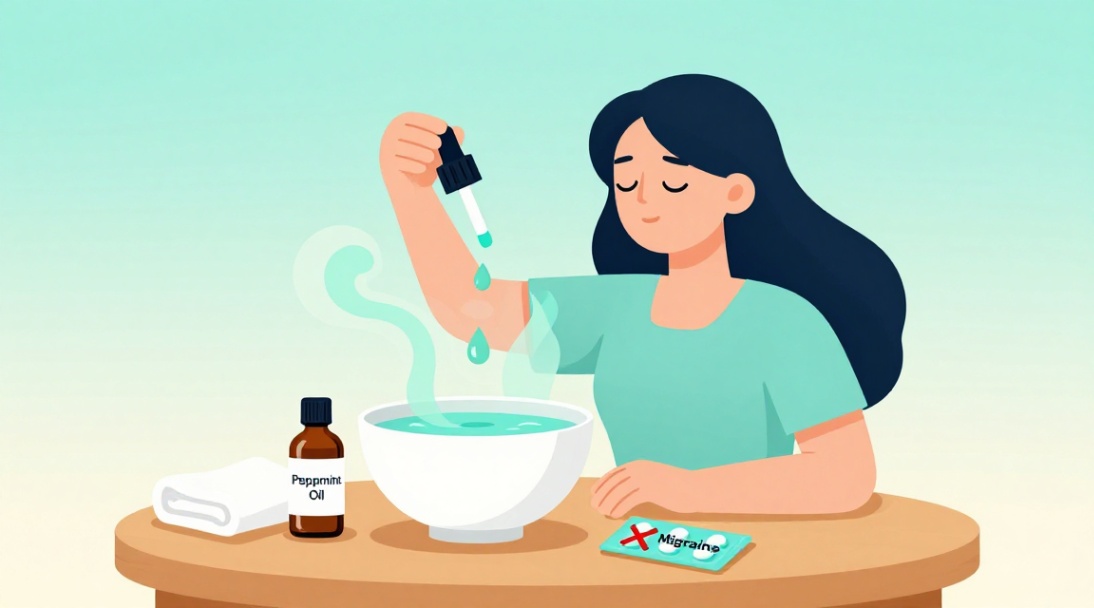
Żid 2 drops of peppermint oil to a skutella of hot (not boiling) ilma. Place your face 12 inches above the bowl. Cover your head and the bowl with a towel. Breathe normally for 5 minuti. Keep your eyes closed. This delivers menthol vapor directly to the nasal passages and sinuses. It works for sinus headaches. It will not touch a vascular migraine.
5. Can Peppermint Oil Replace Migraine Medication?
6. Why Quality of Oil Matters More Than You Think
Most “peppermint oil” on Amazon is adulterated with synthetic menthol, clove leaf oil, jew ewkaliptu. These impurities cause skin burns and offer zero headache relief. Buy oil that states the full botanical name: Mentha x piperita. It should also list the chemotype: high menthol (40-50%) and high menthone (20-30%). GC/MS test results should be available on the seller’s website. Jekk le, tixtrih.
7. Sigurtà: Where NOT to Apply Peppermint Oil
Keep it away from the eyes, nostrils (ġewwa), and broken skin. If it gets in your eye, flush with a fatty oil—not water. Water spreads the menthol. Do not use on children under 6 snin. Menthol can cause glottal spasm and respiratory arrest in infants. Pregnant women can use it topically at 5% dilution in the second and third trimester. Avoid it if you have G6PD deficiency or gallbladder disease.
8. Lavender vs. Peppermint for Headache: Which Wins?
Lavender is anxiolytic. Inaqqas l-istress, which triggers many headaches. Peppermint is directly analgesic. For an active headache, peppermint wins hands down. Lavender works better as a preventive treatment before sleep. If you have both tension and anxiety, uża a 1:1 taħlita. Ħallat 2 drops peppermint + 2 drops lavender per 5 ml carrier oil. Apply to the back of the neck. The combination shortens recovery time.
9. How to Combine Peppermint Oil with a Cold Pack
Apply the diluted oil to your temples first. Then place a gel cold pack wrapped in a thin cloth over your forehead and eyes. The cold pack constricts blood vessels while the oil relaxes muscles. This dual action stops a migraine in 20 minutes for many people. Do not put the cold pack directly on the oiled skin—the cold reduces absorption. Stenna 3 minuti, then apply the cold pack.
10. When to See a Doctor Instead
Peppermint oil will not fix a subarachnoid hemorrhage, meningitis, or a brain tumor. If your headache is sudden and severe (“thunderclap”), or accompanied by fever, stiff neck, slurred speech, or weakness on one side of the body, go to the ER. Do not waste time with oils. Self-treatment is for recurrent, benign tension headaches—not red-flag events.
11. Quick Reference Table: Peppermint Oil Application Methods
| Metodu | Drops | Carrier/Medium | Area | Time to Effect |
|---|---|---|---|---|
| Topical 5% dilwizzjoni | 3 qtar | 5 ml carrier oil | Temples, għonq, forehead | 15 min |
| Inalazzjoni tal-fwar | 2 qtar | 500 ml hot water | Nasal passages | 5 min |
| Direct inhalation | 1 qatra | Tissue or inhaler | Olfactory | 2 min |
| Cold compress synergy | 3 qtar | 5 ml carrier + cold pack | Forehead | 20 min |
12. The Truth about “Therapeutic Grade” Labels
“Therapeutic grade” is a marketing term with no legal definition. The USDA and FDA do not regulate it. Ignore the label. Look at the GC/MS report. A genuine peppermint oil should contain specific ratios of menthol, menthone, and menthofuran. If the seller cannot provide that report, they are selling perfume oil. Perfume oil does not treat headaches.
13. Final Take: Use Peppermint Oil with Precision, Not Faith
Peppermint essential oil for headache relief is not magic. It is neurobiology. Apply the correct dilution to the correct location. Match the method to your headache type. Tension headache? Topical forehead and neck. Sinus headache? Inalazzjoni tal-fwar. Migraine with nausea? Topical plus inhale from bottle. Test it three times. Track the results. If it fails twice, switch to something else. Oil is a tool, not a cure-all. Use it like you would use any medicine: with a plan, a dose, and an exit strategy.
Fornitur
ScentSerenade hija impenjata li tintegra perfettament l-essenza tal-kultura orjentali mal-kreattività moderna biex toħloq prodotti tal-fwieħa kulturali u kreattivi uniċi. Aħna nemmnu li kull fwieħa għandha l-istorja u l-emozzjoni unika tagħha, għalhekk aħna nagħżlu bir-reqqa l-aqwa ingredjenti naturali tad-dinja, flimkien ma 'sengħa exquisite, u tistinka biex tirrakkonta storja kommoventi f’kull flixkun tal-fwieħa.