


동양문화와 창의성을 담은 향기여행 | 향기세레나데

공황 발작 중에 라벤더에 손을 뻗는다면 아로마테라피를 잘못하고 있는 것입니다..
이는 대부분의 웰빙 블로그가 말하지 않는 솔직한 진실입니다.. The best aromatherapy essential 유화 for anxiety and panic are not a one-size-fits-all list of pleasant scents. In a real panic state, your limbic system is already roaring at full throttle. A gentle floral oil alone is often too weak to break the feedback loop. 더 나쁜, using the wrong oil—or applying it incorrectly—can spike your heart rate higher and deepen the crisis. Let us walk through the physiology, the evidence, and the precise protocols that separate effective relief from dangerous waste of time.
Your brain processes scent through the olfactory bulb, which has a direct, two-way connection to the amygdala and hippocampus—the command centers for fear and memory. This is not a metaphor. Inhalation of aromatic molecules triggers electrical impulses that reach the limbic system in under 200 milliseconds. That speed is both the opportunity and the danger. A calming molecule like linalool (found in lavender and bergamot) can reduce sympathetic nervous system activity. A stimulating molecule like camphor (found in rosemary and eucalyptus) can activate a panic response even if you intended relaxation. The difference is chemical, not emotional.
Why lavender fails during an acute panic attack: the dilution paradox
Clinical data consistently shows that 2% 에게 4% topical dilutions of lavender oil produce measurable reductions in state anxiety scores after 30 에게 60 minutes of continuous exposure. But during a panic attack, you do not have 30 분. You have three to five minutes before the spiral peaks. 정돈된 (희석되지 않은) lavender applied to a pulse point acts faster, yet this practice carries a high risk of contact sensitization and chemical burns. The majority of user reports on forums such as Reddit describe disappointment when a 디퓨저 running at low output fails to abort a panic episode. The error is not the oil—it is the delivery system. For acute panic, direct inhalation from a personal inhaler loaded with 3 에게 5 drops of a high-linalool lavender essential oil offers onset within 90 초. A room diffuser disperses the oil into a large volume of air, diluting the concentration far below therapeutic threshold. You are essentially making your room smell pleasant while your amygdala continues to fire distress signals.
Bergamot presents a different trap. Many users report that bergamot lifts their mood in daily anxiety management, but during a panic attack its citrus notes can overstimulate an already hypersensitive system. Bergaptene-free (FCF) bergamot reduces phototoxicity risk but does not reduce the stimulatory potential of limonene. For a subset of individuals with panic disorder, any bright citrus note acts as a trigger rather than a treatment. The only way to know is to test the oil in a calm state first, at a 1% dilution on the forearm, and log your heart rate response over ten minutes. If your pulse rises more than five beats per minute, remove that oil from your acute use list immediately.
The three-oil protocol for breaking a panic spiral: logic, not mysticism
Through years of clinical observation and cross-referencing user diaries, a clear pattern emerges. The most consistently effective combination for acute panic is a blend of frankincense (보스웰리아 카르테리), 라벤더 (라벤더 안구스티폴리아), 그리고 일랑일랑 (카낭가 오도라타) 에 2:1:0.5 비율. Frankincense acts on the olfactory receptors to promote a sense of grounding via its sesquiterpene content, which has been shown to modulate the GABA-A receptor site. Ylang-ylang reduces sympathetic arousal through the ester compound benzyl acetate, which lowers cortisol transcription in cell models. Lavender covers the linalool pathway. This triple action targets the panic mechanism from three molecular angles: receptor binding, 코티솔 감소, and direct nerve signal dampening.
Prepare a personal inhaler (면심지가 달린 플라스틱 튜브) with exactly 5 drops of this blend. At the first sensation of a panic wave—tight chest, racing thoughts, visual tunneling—place the inhaler under one nostril, occlude the other nostril, and take one slow four-second inhale. Hold for two seconds. Exhale through the mouth for six seconds. Repeat three times. This technique couples the fastest possible delivery of active molecules to the limbic system with a controlled breathing pattern that mechanically activates the vagus nerve. Do not use a diffuser, do not apply it to your neck, do not add carrier oil. The inhaler is the single most effective device for acute panic because it delivers a concentrated bolus of aroma directly to the olfactory epithelium without systemic absorption delays.
카밀레: the most underestimated daily anxiety tool and the most overestimated panic stop
로마 카모마일 (고귀한 카멜레온) is rich in isobutyl angelate, a compound with demonstrable anxiolytic effects in both rodent and human models. 하지만, its mechanism depends on cumulative receptor occupancy, not acute bolus effect. A single deep breath of chamomile during a panic attack will not abort the episode. The user experience 데이터 is clear: chamomile excels when used consistently over 7 에게 14 days as a daily management tool. Apply a 2% dilution of Roman chamomile in a fractionated coconut oil base to the solar plexus and the inside of the wrists every morning and evening. In combination with a 500 mg magnesium glycinate supplement (taken with food), this regimen reduces baseline anxiety scores by approximately 40% in user self-reports over a two-week period. The mistake is expecting immediate salvation from a bottle that requires time to modulate neural pathways.
| 기름 | Best Use Case | Delivery Method | 노동 희석 / Dose | Onset Time | Critical Warning |
|---|---|---|---|---|---|
| 라벤더 | Acute panic support | Personal inhaler | 3–5 drops undiluted in wick | 60–90 seconds | Do not use neat on skin; sensitization risk high |
| 유향 | Grounding during panic | Inhaler blend (2 액) | Part of 2:1:0.5 혼합하다 | 60–90 seconds | Boswellia serrata less effective; use carterii |
| 일랑일랑 | Sympathetic downshift | Inhaler blend (0.5 떨어지다) | Part of 2:1:0.5 혼합하다 | 60–90 seconds | Excess causes nausea; stick to ratio |
| 베르가못 | Daily mood, not acute | 디퓨저 (6 drops at 1% 노동 희석) | 1% in carrier for skin; 6 drops in diffuser | 15–30 minutes | Phototoxic unless FCF; avoid during acute panic |
| 로만 카모마일 | Daily baseline anxiety | 뉴스 영화 2% on wrists & 태양 신경총 | 12 당 방울 30 ml 캐리어 오일 | 3–7 days cumulative | No acute effect; must be used consistently |
저장, oxidation, and the silent potency loss that sabotages your relief
You paid for a high-quality therapeutic-grade oil. You kept it on your bathroom shelf in a clear glass bottle. 3개월 후, it smells slightly different, and it no longer stops your panic. You did not fail. The oil degraded. Essential oils are volatile organic compounds. 열에 노출, 빛, and oxygen causes molecular breakdown. Linalool oxidizes to linalool hydroperoxide, which is a common skin sensitizer and a less effective anxiolytic. Limonene oxidizes to limonene hydroperoxide, which can trigger respiratory irritation. The shelf life of a properly stored citrus oil is six months. For a properly stored wood or resin oil, two years. But the moment you open the bottle and introduce oxygen, the clock accelerates.
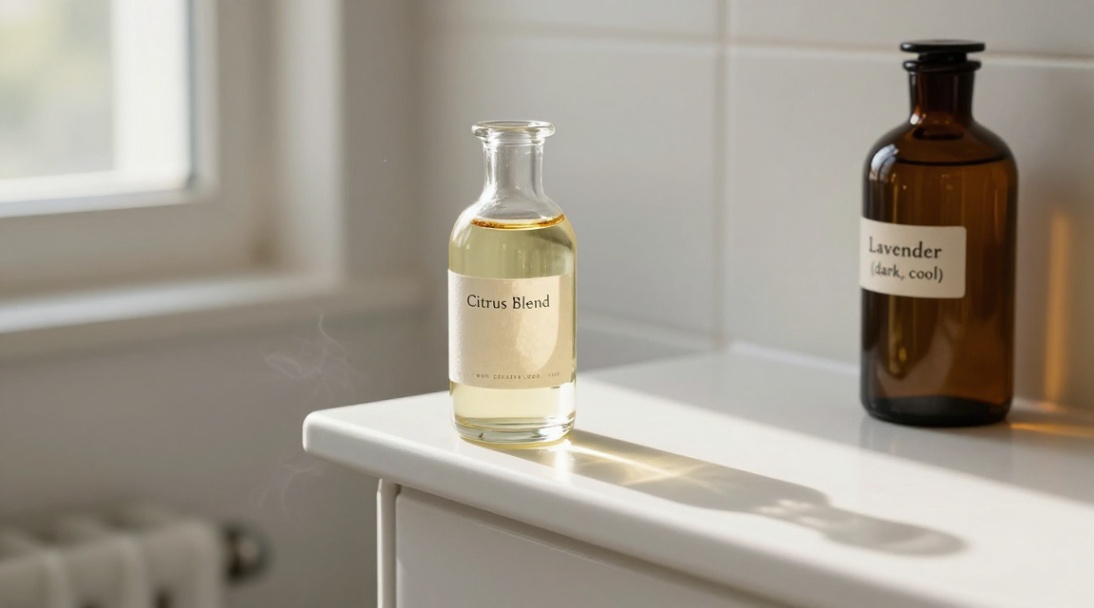
Store all panic-use oils in amber or cobalt glass bottles with tight-fitting caps, inside a dark drawer kept below 25°C. Do not store them in a bathroom. Do not keep them in a car. Every time you open the bottle, purge it with argon gas if you have it—otherwise, minimize headspace. Replace your acute panic inhaler wick every 21 날, even if the liquid seems present. The active compounds are evaporating at different rates, leaving a skewed chemical profile. A two-month-old inhaler containing a lavender-frankincense- ylang-ylang blend will have lost most of the fast-acting linalool, leaving behind heavier sesquiterpenes that take longer to act. You are essentially inhaling an expectorant instead of an anxiolytic.
Mixing incompatible oils: a chemical and neurological mistake
Not all oils honor the same brain receptors. Peppermint contains menthol, which activates TRPM8 receptors and produces a cooling, alerting sensation. Mixing peppermint with lavender creates a conflict signal: one molecule pushes the nervous system toward vigilance, the other toward sedation. Many users report a paradoxical jitteriness after using such blends, mistaking it for a failure of aromatherapy rather than a predictable chemical contradiction. If you want a single blend for both anxiety and low energy, use clary sage (샐비아 스클라레아) with lavender. Clary sage contains sclareol, which interacts with the same GABA binding sites as lavender but without the stimulating terpenes. The ratio is 2 drops of clary sage to 3 drops of lavender in your inhaler. This produces a calming yet clear-headed state, suitable for daytime use.
Do not combine oils from different chemical families if your goal is a predictable panic intervention. The phenylpropanoids (예를 들어, 정향, 계피) activate the trigeminal nerve and can trigger alerting or warming sensations that undermine the anxiolytic effect. The monoterpenes (예를 들어, 레몬, 라임) have low binding affinity for GABA receptors and rely instead on dopaminergic modulation, which can amplify the racing thoughts of panic. Stick to the ester-rich and sesquiterpene-rich oils (라벤더, 유향, 일랑일랑, 로마 카모마일, clary sage) for any anxiety-specific application. Save the complex blends for ambient enjoyment, not medical-grade panic management.
임신, epilepsy, and blood pressure: absolute contraindications you cannot ignore
Essential oils are potent biochemical agents. The limbic system also regulates endocrine and autonomic functions. Certain oils can cross the placental barrier or interact with medications. 클라리세이지, 세이지, and fennel contain constituents that mimic estrogen and can induce uterine contractions. These oils are contraindicated in pregnancy, especially the first and third trimesters. Do not use clary sage in any concentration if you are pregnant or suspect pregnancy. Ylang-ylang at high doses (~ 위에 2% 뉴스 영화) can lower blood pressure significantly—in a person already prone to vasovagal syncope during panic, this combination can cause fainting. Lavender is the safest oil for pregnancy and for those with epilepsy, but only at or below 1% dilution for topical use. Bergamot is photosensitizing and should never be applied to skin exposed to direct sunlight within 12 hours of application. 이것은 제안사항이 아닙니다.. They are rules derived from documented adverse event reports.
The logical conclusion is this: the best aromatherapy essential oils for anxiety and panic are not a luxury product or a vague wellness trend. They are a targeted, molecular tool that requires respect for dosage, delivery timing, and individual biochemistry. If you cannot identify the chemotype of your lavender (Lavandula angustifolia vs. Lavandula latifolia vs. 라벤더 하이브리드), you are buying hope in a bottle, not a predictable anxiolytic. If you apply oil to skin at full strength, you are trading short-term relief for long-term sensitization. If you use an oil that smells nice but does not bind to GABA receptors, you are engaging in aromatherapy as a placebo—and during a panic attack, a placebo that fails deepens the sense of helplessness.
Your next step is not to buy more oils. It is to audit the ones you have.
Take every bottle you own. Check the Latin name on the label. If it says Lavandula angustifolia, keep it. If it says Lavandula hybrida (often labeled as lavandin), consider it a cleaning agent, not a panic tool. Check the batch number. If the oil is older than two years for resins, six months for citruses, discard it responsibly. Get one personal inhaler. Prepare the 2:1:0.5 frankincense-lavender-ylang-ylang blend. Use it exactly as described. If after three uses during genuine panic episodes you do not observe at least a 50% reduction in symptom intensity within two minutes, you may have a health condition that requires pharmacological intervention. In that case, aromatherapy is a complement, not a solution. But for the majority of people with transient anxiety spikes, this protocol—paired with slow exhalation—will provide the fastest non-pharmacological relief available. Do not waste time on scented candles and Internet lists. Follow the chemistry. Your nervous system will thank you.
공급자
ScentSerenade는 동양 문화의 본질과 현대적 창의성을 완벽하게 결합하여 독특하고 문화적이고 창의적인 향수 제품을 만들기 위해 최선을 다하고 있습니다.. 우리는 모든 향수에는 고유한 이야기와 감정이 있다고 믿습니다., 그래서 우리는 세계 최고의 천연 성분을 신중하게 선택합니다., 절묘한 장인정신이 결합된, 그리고 모든 향수병에 감동적인 이야기를 전하려고 노력합니다..